Building medX: Making Medical AI Auditable, Context-Aware, and Clinician-Friendly

AI is moving too quickly across almost every industry. In software, engineering, finance, education, and operations, we are seeing AI systems help people work faster, automate repetitive tasks, and make better use of data and information.
Healthcare is different.
The medical industry is not a place where speed alone is enough. A system cannot simply produce an answer and expect clinicians to trust it. In healthcare, every interpretation must be explainable. Every recommendation must be traceable. Every step must respect patient privacy, clinical accountability, and the reality of how doctors actually work.
That is the problem we are building medX around.
medX is a healthcare AI startup focused on helping clinicians make sense of fragmented patient data, and we are starting with blood test interpretation and longitudinal patient profiles.
Our goal is not to replace clinicians. Our goal is to build a workflow support tool that fits naturally into clinical practice: auditable, context-aware, easy to use, and designed around the way consultations happen.
1. How it started
My background is in Mechanical Engineering and Data Science at the National University of Singapore. I first became interested in applied AI through building systems that could turn messy, complex data into insightful output and analysis.
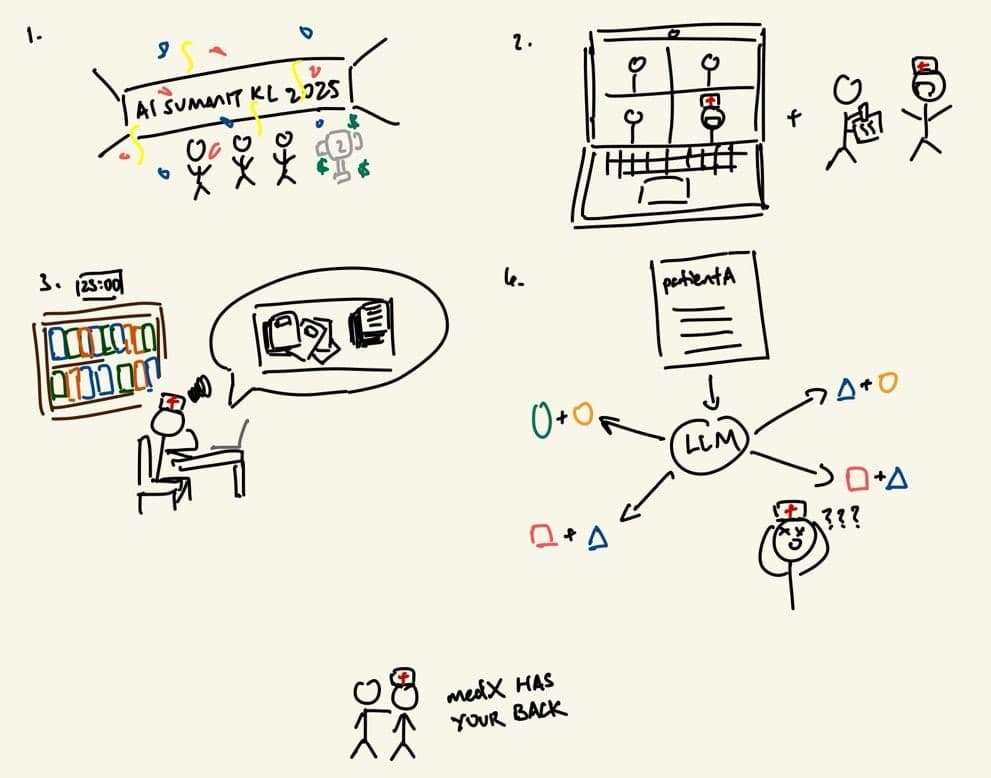
I met my co-founders while working together at a data science startup. We were experimenting with machine learning, product building, and real-world data problems in the field of engineering and law, but our first serious step into healthcare AI came during the ASEAN AI Summit 2025 in Kuala Lumpur.
As a team, we joined our first hackathon and built a brain tumor segmentation system using the BraTS dataset. We trained a deep learning model from scratch and integrated a multi-annotator prediction algorithm that estimated the likelihood of tumor analysis and diagnosis using confidence scores and trust scores based on past cases.
We won 2nd runner-up. More importantly, the project opened doors to conversations and discussions with angel investors, oncologists, and healthcare professionals.
2. What we learned
At first, we were excited by the technical achievement. The model worked, the system produced meaningful outputs, and the demo was well received by industry professionals.
But the conversations that followed were far more valuable than anything else. Speaking with clinicians helped us realize that in healthcare, building an AI model that performs well on a task is only the beginning. The harder question is whether the system can be trusted, explained, audited, and integrated into clinical workflow without creating more work for the doctor.
That insight shifted how we thought about medical AI.
Although our hackathon project focused on medical imaging, the deeper problem we kept hearing was not limited to imaging. Clinicians were dealing with fragmented patient information across reports, notes, visits, and systems. The data was often available, but not always organized in a way that was useful during a real consultation.
3. The problem we see
Around the same time, I was working on a freelance project for a small-sized TCM and wellness clinic in Kuala Lumpur. The goal was to build a prototype for biomarker analysis using an agentic RAG pipeline.
That project gave us a practical entry point into the same problem we had started to notice after the hackathon.
Blood test reports were often scattered across PDFs, past visits, patient notes, and separate systems. A clinician might have access to the information, but not in a format that was immediately useful during a consultation. Important context could be buried in old documents. Trends across visits were not always easy to see. Even when the data existed, it was not always presented in a way that supported fast, confident interpretation and diagnosis.
Initially, the system looked like many AI products today: take medical data, pass it into a large language model and generate an explanation.
But the more we worked on it, the clearer it became that this approach was not enough. A simple LLM wrapper is not suitable for practical medical workflow support.
It may produce a convincing answer, but the output will vary across runs. It may miss context, it may hallucinate, and it may cite weak or irrelevant information. Most importantly, it is difficult — almost impossible — to audit exactly how the system moved from input to conclusion.
That was when we decided to refactor the entire pipeline.
Instead of asking an LLM to interpret everything directly, we began designing medX around deterministic layers, structured patient profiles, knowledge graph retrieval, and auditable reasoning steps.
The principle was simple: every step should be traceable.
4. Why not LLM?
Large language models are powerful. They are fast, flexible, and capable of generating impressive explanations.
But in clinical environments, flexibility can also be a weakness.
If the same input can produce slightly different outputs across multiple runs, that becomes a problem. If the reasoning path is hidden, that becomes a problem. If the model can generate unsupported claims, that becomes a problem.
Doctors do not need a black box that sounds confident — they need a system that can show its work.
At medX, we are not trying to remove LLMs from the workflow. Instead, we believe they should be used carefully, in the right parts of the system.
The medical interpretation process should not begin with a language model guessing from a large context window. It should begin with structured, auditable steps:
- OCR extracts information from reports.
- Deterministic layers normalize biomarkers, units, reference ranges, and abnormality states.
- Patient profiles preserve longitudinal context across visits.
- A clinical knowledge layer retrieves relevant relationships between biomarkers, abnormalities, patterns, and possible hypotheses.
- Only then should an AI assistant help summarize, explain, and interact with the clinician.
This makes the system slightly slower than a pure chatbot in some cases. But in healthcare, the goal is not to be the fastest black box. The goal is to be reliable, explainable, and useful in real clinical workflows.
What we are building
medX helps clinicians review blood test results in the context of each patient's medical history, past visits, and lab trends over time.
A single blood test value rarely tells the full story. What matters is whether it has changed over time, whether it is near a clinical boundary, whether it appears alongside other abnormalities, and whether it fits the patient's history, medications, symptoms, or previous conditions.
At a high level, medX turns raw patient information into a structured patient profile.
When a new blood test is uploaded, the system extracts and normalizes the results, compares them against reference ranges and patient history, identifies relevant patterns, and surfaces explanations that clinicians can inspect.
The clinician can then ask questions such as:
- “What changed since the last visit?”
- “Which markers are abnormal?”
- “Are there any recurring patterns?”
- “What should I pay attention to before explaining this to the patient?”
The important part is that the system is not just generating text. It is preserving the path from data to interpretation.
A clinician should be able to inspect the source report, the extracted values, the trend, the relevant patient facts, and the reasoning behind the output, all within the same platform.
That is what we will be achieving with auditable medical AI.
Why this matters for clinics
For patients, this means clearer explanations and more personalized care.
For clinicians, the value is workflow efficiency. Faster review, less time spent searching through old documents, and more context during consultations.
For clinics, the value is operational leverage. Smoother workflows, better documentation, and more efficient patient conversations.
A good medical AI system should not force doctors to change the way they work. It should reduce the amount of repetitive review they need to do before, during, and after consultations.
If a clinician can understand a patient's longitudinal context faster, explain results more clearly, and spend less time searching through old documents, consultations become more efficient.
That can mean shorter review time, smoother patient conversations, better documentation, and potentially higher clinic capacity.
This is important because adoption in healthcare is not only about better technology. It is about convenience.
Doctors are busy. Clinics are busy. Most healthcare teams do not want to learn a complicated new system just because it uses AI. The product has to feel natural. It should require minimal setup. It should fit into the consultation flow. It should make the clinician's work easier from the first use.
Our belief
Blood test interpretation is only the starting point.
The broader vision is to build an AI clinical workflow layer that can help healthcare professionals make better use of patient data across repeated visits.
Over time, this could extend into medical imaging, specialist workflows, chronic disease monitoring, preventive health, and other areas where patient context matters.
The future of medical AI should not be a single chatbot answering isolated questions. It should be a reliable assistant that understands patient history, preserves clinical context, supports decision-making, and provides explanations that clinicians can verify.
We believe the strongest healthcare AI systems will combine the speed of modern AI with the discipline of structured medical reasoning.
Speed is useful. Accuracy is important. But in healthcare, reliability is what earns trust.
That is what we are building at medX.
An AI system that does not just answer, but shows its work.